
 |
 |
Blessed by year-round sunshine, moderate temperatures and its seemingly endless variety of things to see and do, Los Angeles is among the nation’s premier destinations.
Attendees are encouraged to plan a vacation around the Triennial Meeting, and arrive one or more days before the opening of the meeting on Thursday, and/or stay beyond its close on Sunday, September 27.
Optional activities for those not attending triennial business sessions are too numerous to list, and no doubt many will plan their own day individually. Whether it is culture or the sights, there is something for everyone in Los Angeles.
For information about airports, transportation, informational guides, restaurants, nightlife, events and travel resources, check out Discover Los Angeles, an important resource for visitors to Los Angeles.
 |
The following are among the many possibilities to consider:
CULTURE
AUTRY NATIONAL CENTER

The Autry National Center celebrates the American West through three important institutions: the Museum of the American West, the Southwest Museum of the American Indian, and the Institute for the Study of the American West.
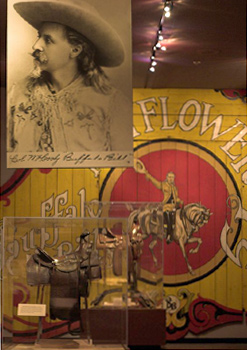
The Museum of the American West provides rich learning opportunities for all people by exploring the myths and realities of the American West and its diverse populations. The museum enhances our understanding of the present by collecting, preserving, and interpreting objects and art, making connections between people today and those who have shaped the past. The Museum of the American West presents thought-provoking exhibitions and an ongoing and dynamic mix of programs and events that can be enjoyed throughout the year. The Museum is located at the Autry National Center in Griffith Park.
GETTY CENTER - Los Angeles
 The
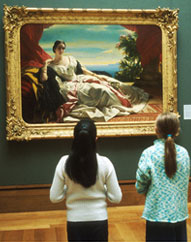
Getty Center Los Angeles presents the Getty's collection of Western art from the Middle Ages to the present against a backdrop of dramatic architecture, tranquil gardens, and breathtaking views.. European paintings, drawings, manuscripts, sculpture and decorative arts, and European and American photographs.
The
Getty Center Los Angeles presents the Getty's collection of Western art from the Middle Ages to the present against a backdrop of dramatic architecture, tranquil gardens, and breathtaking views.. European paintings, drawings, manuscripts, sculpture and decorative arts, and European and American photographs.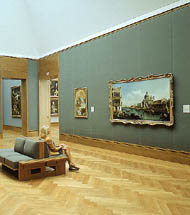
The collection of the J. Paul Getty Museum on display in the galleries at the Getty Center includes examples of pre-20th-century European paintings, drawings, illuminated manuscripts, sculpture, and decorative arts; and 19th- and 20th-century American and European photographs. The galleries at the Getty Center are housed in the Museum's five exhibition pavilions, plus the Getty Research Institute Exhibition Gallery.
GETTY VILLA - Malibu
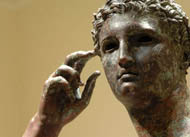
The Getty Villa houses the J. Paul Getty Museum's collection of approximately 44,000 Greek, Roman, and Etruscan antiquities. Over 1,200 works are on view in 23 galleries devoted to the permanent collection, with five additional galleries for changing exhibitions.
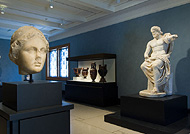
With objects dating from 6,500 B.C. to A.D. 400, the collection contains monumental sculptures as well as artifacts of everyday life such as vases, coins, sculpture, and jewelry. Some of the objects, including a mummy, have never been on view.
HUNTINGTON LIBRARY, ART COLLECTIONS AND BOTANICAL GARDENS
Once the home of Henry E. Huntington (1850–1927), longtime member of the California SR, and his wife, Arabella (1850–1924) the 55,000-square-foot Beaux-Arts interpretation of an Italian Renaissance villa was hailed as the finest residence in Southern California when it was completed in 1911.
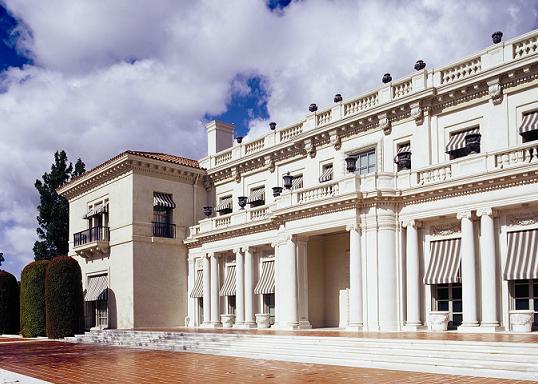
It was designed by Myron Hunt (1868–1952) with Elmer Grey (1872–1963) and decorated under supervision of the Duveen Brothers of London.
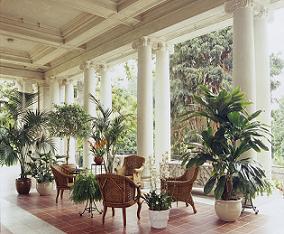
The Huntington Art Gallery opened in 1928 displaying one of the greatest collections of 18th-century British art in the country, including the celebrated Blue Boy by Thomas Gainsborough and View on the Stour near Dedham by John Constable, as well as a valuable collection of French decorative arts.
The Huntington Art Gallery was established by the founder to retain the character of an 18th-century manor. Originally the home of Mr. and Mrs. Huntington, the Huntington Art Gallery contains a collection of British and Continental art, eloquently bringing to life a segment of the past, bounded roughly by the French and American revolutions, through paintings, furniture, sculpture, tapestries, silver, miniatures, drawings and watercolors, prints, and porcelain.

The Main Gallery contains one of the finest collections of full-length 18th-century British portraits to be found outside of Britain, and provides an unrivaled opportunity to study British art.
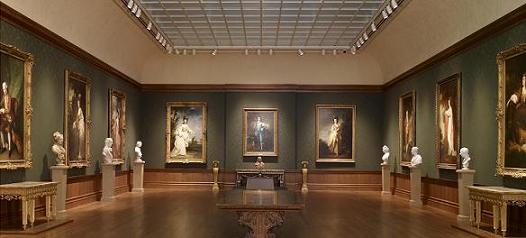
Masterpieces include works by such artists as Constable, Romney, Reynolds, Van Dyck, and Turner, as well as the Blue Boy by Gainsborough and Pinkie by Lawrence.
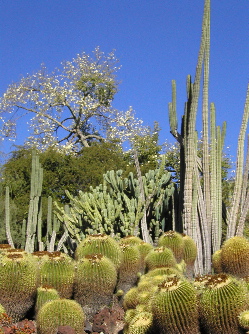
The Huntington Desert Garden is one of the largest and oldest assemblages of cacti and other succulents in the world.
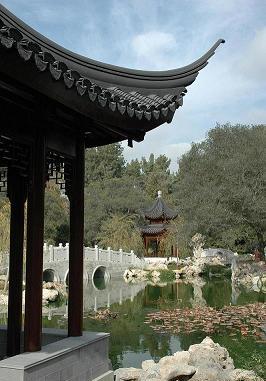
Inspired by the centuries-old Chinese tradition of private gardens designed for scholarly pursuits, Liu Fang Yuan, or the Garden of Flowing Fragrance, combines the scenic beauty of nature with the expressiveness of literature to give deeper meaning to the landscape. A walk through its paths enriches the mind and spirit alike. The Huntington—with its renowned collections of art, rare books, manuscripts, and plants—was founded on this same philosophy by Henry E. Huntington in 1919.